
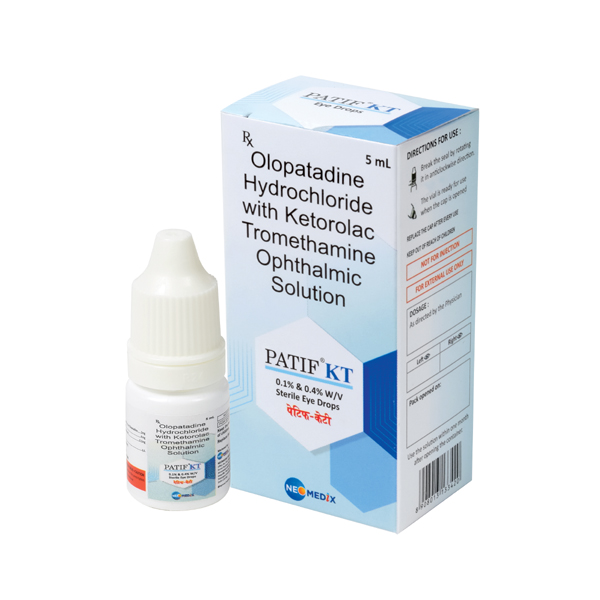
PATIF-KT | Olopatadine Hydrochloride with Ketorolac Tromethamine Ophthalmic Solution
Composition:
Each ml Contains:
Olopatadine Hydrochloride IP Equivalent to Olopatadine………………………..1 mg
Ketorolac Tromethamine IP…………………………………………………………………4 mg
Benzalkonium Chloride Solution IP (As Preservative)………………………………0.1 mg
Water for injection……………………………………………………………………………..q.s.
Pharmaceutical Form: Eye Drops, Solution
Clinical Particulars – Therapeutic Indications: For the treatment of signs and symptoms of seasonal allergic conjunctivitis (SAC)
Posology & Method of Administration: One drop in each affected eye, two times daily.
Pediatric Population: Safety and efficacy have not been established.
Elderly Population: No overall differences in safety or effectiveness have been observed between elderly and young patients.
Method of Administration: For ocular use. NOT FOR INJECTION.
Contraindications: Hypersensitivity to the active substance or to any of the excipients of the formulation.
Special Warnings and Precautions for use:
- Delayed Healing: Topical NSAIDs may slow or delay healing. Topical corticosteroids are also known to slow or delay healing. Concomitant use of topical NSAIDs and topical steroids may increase the potential for healing problems.
- Corneal Effects: Use of topical NSAIDs may result in keratitis. In some susceptible patients, continued use of topical NSAIDs may result in epithelial breakdown, corneal thinning, corneal erosion, corneal ulceration or corneal perforation. These events may be sight threatening. Patients with evidence of corneal epithelial breakdown should immediately discontinue use of topical NSAIDs and should be closely monitored for corneal health.
- Post marketing experience with topical NSAIDs also suggests that use more than one day prior to surgery or use beyond 14 days post-surgery may increase patient risk for occurrence and severity of corneal adverse events.
- Risk of Contamination: Do not touch the dropper tip or other dispensing tip to any surface since this may contaminate the solution. Serious damage to the eye and subsequent loss of vision may result from using contaminated solutions.
- If irritation persists or increase, discontinue use and consult the physician.
- Contact Lens Wear: Patients should be advised not to wear contact lenses if their eye is red. Patients who wear soft contact lenses and whose eyes are not red should be instructed to wait for atleast 10 minutes after instilling Patif KT before reinsertion of lenses.
Interaction with other Medicinal Products and Other Forms of Interaction: There is the potential for cross-sensitivity to acetyl salicyclic acid, phenyl acetic cid derivatives and other NSAIDs. There have been reports of bronchospasm or exacerbation of asthma associated with the use of Ketorolac Tromethamine ophthalmic solution in patients who have either a known hypersensitivity to aspirin/nonsteroidal anti-inflammatory drugs or a past medical history of asthma. Therefore, caution should be used when treating individuals who have previously exhibited sensitivities to these drugs.
Increased Bleeding Time: With some nonsteroidal anti-inflammatory drugs, there exists the potential for increased bleeding time dur to interference with thrombocyte aggregation. There have been reports that ocularly applied NSAIDs may cause increased bleeding of ocular tissues (including hyphemas) in conjunction with ocular surgery.
Pregnancy and Lactation – Pregnancy
Olopatadine Hydrochloride: No adequate and well controlled studies in pregnant women. To be used in pregnant women only if the potential benefit to the mother justifies the potential risk to the embryos or fetus.
Ketorolac Tromethamine: No adequate and well-controlled studies in pregnant women. To be used during pregnancy only if the potential benefit justifies the potential risk to the embryo or fetus.
Nonteratogenic Effects: Because of the known effects of prostaglandin-inhibiting drugs on the fetal cardiovascular system (closure of the ductus arteriosus), the use of ketorolac Tromethamine ophthalmic solution during late pregnancy should be avoided.
Nursing Mothers: Caution should be exercised when Olopatadine Hydrochloride with Ketorolac is administered to a nursing woman.
Effects on Ability to Drive and Use Machines: Ophthalmic solution containing Ketorolac has no or negligible influence on the ability to drive and use of machinery. Transient blurring of vision may occur on instillation of eye drops. Do not drive or use hazardous machinery unless vision is cleared.
Undesirable Effects
Olopatadine Hydrochloride with Ketorolac Tromethamine: Safety of fixed dose combination of olopatadine hydrochloride 0.1% with ketorolac tromethamine 0.4% was compared with olopatadine hydrochloride 0.1% ophthalmic solution in 129 patients (Olapatadine plus Ketorolac, n=66, olopatadine, n=63) with seasonal allergic conjunctivitis in a randomized open label, multicenter trial. The adverse events reported with the fixed dose combination was mild transient blurring 1.5% (1/66), eye irritation 1.5% (1/66) and stinging 1.5% (1/66). The most frequently reported adverse event with olopatadine was mild transient burning 4.5% (3/63).
Olopatadine Hydrochloride: Headaches have been reported at an incidence of 7%. Other adverse experiences that have been reported in less than 5% of patients are asthenia, blurred vision, burning or stinging, cold syndrome, dry eye, foreign body sensation, hyperemia, hypersensitivity, keratitis, lid edema, nausea, pharyngitis, pruritis, rhinitis, sinusitis and taste perversion.
Ketorolac Tromethamine: The most frequently reported adverse events with the use of ketorolac tromethamine 0.4% ophthalmic solution occurring in approximately 1 to 5% of the overall study population were conjunctival hyperemia, corneal infiltrates, headache, ocular edema and ocular pain. The most frequent adverse reactions reported with the use of ketorolac tromethamine ophthalmic solutions have been transient stinging and burning on instillation. These reactions were reported by upto 40% of patients participating in clinical trials. Other adverse reactions occurring with ketorolac tromethamine ophthalmic solution in approximately 1 to 10% of the time during treatment include allergic reactions (including eyelid swelling, eyelid edema and hyperemia), corneal edema, iritis, ocular inflammation, ocular irritation, superficial keratitis and superficial ocular infections. Other adverse reactions reported rarely with the use of ketorolac tromethamine ophthalmic solutions include-corneal ulcer, eye dryness and visual disturbance (blurry vision).
Ocular Toxicity Study: Ocular toxicity study of Olopatadine Hydrochloride with Ketorolac Tromethamine ophthalmic solution was carried out in rabbit species for twenty eight days with repeated dosing every day. Olopatadine Hydrochloride with Ketorolac Tromethamine ophthalmic solution was administered to groups of 2 rabbits of each sex into both eye of each rabbit daily. The drugs were administered four times with the one hour interval for twenty eight consecutive days and then sacrificed and subjected to a complete necropsy. The untreated groups and the high dose groups were further observed for a post-treatment period of fourteen days to permit evaluation of the persistence, reversibility or delayed occurrence of toxic effects. Olopatadine with Ketorolac ophthalmic solution did not cause any treatment related ocular toxicity, significant toxicological effect on hematological, biochemical and urinanalysis parameters or treatment related gross pathological and histopathological alterations in the tissues of male and female rabbits.
Pharmacological Properties
Pharmacodynamic Properties: Pharmacotherapeutic group: Antihistamines and Anti-Inflammatory agents in combination.
Mechanism of Action: Olopatadine Hydrochloride with Ketorolac Tromethamine is a fixed dose combination eye drop, which contains Olopatadine Hydrochloride, a dual acting mast cell stabilizer with antihistaminic activity and Ketorolac Tromethamine, a nonsteroidal anti-inflammatory agent.
Olopatadine Hydrochloride: Olopatadine is an inhibitor of the release of histamine from the mast cell and a relatively selective histamine H1-receptor antagonist that inhibits the in vivo and in vitro type 1 immediate hypersensitivity reaction, including inhibition of histamine induced effects on human conjunctival epithelial cells.
Ketorolac Tromethamine: Ketorolac Tromethamine is a nonsteroidal anti-inflammatory drug which, when administered systemically, has demonstrated analgesic, anti-inflammatory and anti-pyretic activity. The mechanism of its action is thought to be due to its ability to inhibit prostaglandin biosynthesis.
Clinical Efficacy & Safety: In a randomized, open label, multicenter clinical trial, efficacy of a fixed dose combination of Olopatadine Hydrochloride 0.1% with Ketorolac Tromethamine 0.4% was compared with Olopatadine Hydrochloride 0.1% in patients with seasonal allergic conjunctivitis for twenty one days. Fifty patients in each arm were considered for efficacy analysis. The olopatadine with ketorolac combination was found to be significantly more effective than olopatadine in treating the signs and symptoms of seasonal allergic conjunctivitis like itching, conjunctival hyperemia, episcleral hyperemia and chemosis. Both the study drugs were equally effective in controlling mucous discharge. Patients in both the treatment groups showed excellent tolerance and good acceptability.
Packaging information: Patif KT vial of 5ml